Lino Cutters
Essdee Lino Cutters are manufactured from high-carbon steel in eleven different styles. These sharp, durable Lino Cutters are precision-ground to an optimum angle to provide effortless Lino cutting.
Lino Cutting & Printing Kit Contents
Safety Cutter
Safety Cutter Precision ground safety lino cutters with a recessed cutting edge. Ideal for younger or less experienced users. These easy-to-use cutters have especially designed “wings” to protect your hand and allow safe cutting. The wings also prevent the cutter from carving too deeply resulting in a consistent, clean cut line every time.

Lino Cutter No.1
For fine lines and cross hatching. Never push any cutter deeper than the sides of the point. A line of 0.5mm or less is possible on SoftCut material. Take care when inking over fine lines as they can fill in.

Lino Cutter No.2
A universal and easy to use tool with a low angle of attack. Commonly used as a basic first-time tool to cut lines up to 1.5mm or less.

Lino Cutter No.3
A tight, round cutter able to cut a 2mm deep-sided line. Good for straight lines. Great in SoftCut but cut too deep in lino and the upright walls of the cut can leave little support and weaken the top surface. With practice, it’s useful for cutting small circles by using a swivel motion.

Lino Cutter No.4
A wide, rounded “v” cutter for lines 3mm wide with 45° walls for a strong print surface, particularly important for fragile detail and fine lines in large open spaces

Lino Cutter No.5
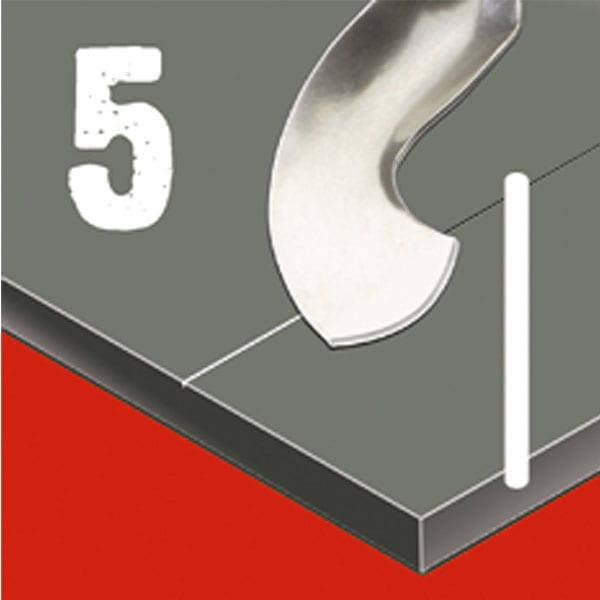
A thin line-marking tool for making the first lines to define the design before using other cutters to remove the unwanted background. It can be pushed or dragged across the surface and turned very easily to describe curves and wavy lines. Cut deep into the lino or SoftCut to define the limit of material removal particularly useful with SoftCut as the material can cling at the end of a cut.
Lino Cutter No.6
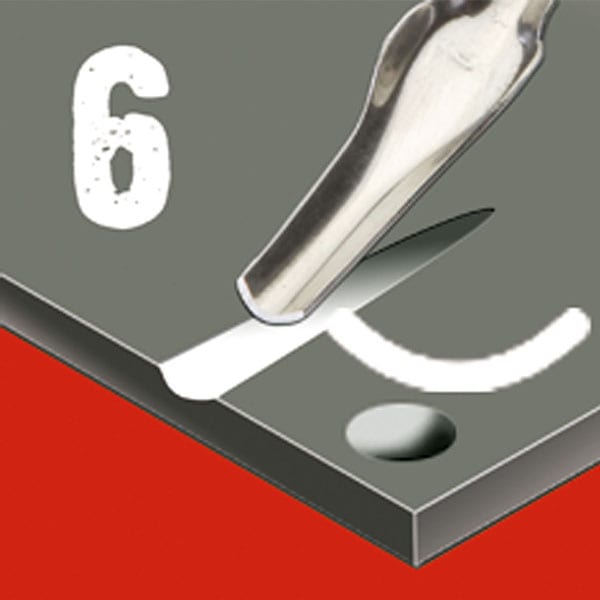
A flat radius cutter for shallow, wide cuts or for shaving at a side wall to reduce the printed area, leaving a strong shallow angle. Swivelling vertically will cut up to 4mm circles on SoftCut.
Lino Cutter No.7
A flat-bottomed wide cutter with safety edges each side. Use the blunt sides to prevent shaving the edge of a previously cut area. Will remove a 3mm-wide flat trough or clear large areas.

Lino Cutter No.8
A wide, deep cutter for lines up to 6mm wide. Avoid cutting too deep. Good for bold lines.

Lino Cutter No.9
A deep “v” cutter for narrow lines. Glides through lino. Avoid cutting too deep. Good also on tougher materials.

Lino Cutter No.10
Similar to 9 but with a wider “v” and a more rounded base to produce lines up to 3.5mm wide. Good also on tougher materials.

How to use Lino Cutters to make a print
This guide uses SoftCut as the carving material, but Essdee lino cutters can also be use on Lino and MasterCut.

1. Transfer your design by drawing directly on the Softcut
Essdee Softcut Lino is an easy to carve material designed especially for relief printing. You can draw directly onto the Softcut block with a pencil or transfer your design using tracing paper. Remember, when you make your print the design will be reversed, so take care with lettering and numbers.
2. Carve Your Design
Lino cutters are sharp! Never carve towards your hand. Always carve away from your body with your spare hand behind the blade. Never use excessive force when cutting and practice your technique to avoid slips.
The narrow number 1 Lino Cutter is great for fine lines and cross hatching. It can be used at a moderately steep angle to give a sharp, deep and narrow cuts.
The U- Shaped number 2 Lino Cutter is a universal and easy to use cutter which can be used at a shallower angle to produce a variety of wider cuts.


3. Roll Out Ink
Block printing ink can stain! Always wear protective clothing and take care to protect furniture. When you are ready to make a test print, take the ink and squeeze out a small 1- or 2-centimetre length of ink onto an ink tray, flat plate, tile or piece of glass. Using the ink roller (also known as a brayer) make short strokes to spread out the ink and evenly coat the roller. Lift the roller regularly to avoid repeatedly working the ink in the same areas. The ink makes a sticky sound when the roller is coated with a thin layer of ink.
4. Roll Ink Onto Block
Place your finished linocut onto a flat surface and roll the ink onto the block, making sure you transfer the ink as smoothly and evenly as possible. Avoid rolling ink into the cut areas. If the ink coverage becomes bare or patchy then add extra ink.


5. Apply paper and transfer ink to paper
Place the paper over your design and press down lightly with your hand. Try to avoid moving the paper to avoid a blurry or smudged print. Press down on the back of the paper with the back of a wooden spoon, applying pressure and making sure you cover your entire print. Partially peel back the paper and check for a good transfer of ink.
6. The Big Reveal!
If you are happy with the transfer, it is time for the Big Reveal! Hang your masterpieces up to dry. The ink may dry quickly or take many hours to dry depending on the thickness of the ink application and ambient conditions. Why not share your results with us on social media!


7. Cleaning Up
Wipe any excess ink from your roller and ink plate using kitchen towel or newspaper and place in your bin. Your roller and ink plate can then be cleaned by running under a tap until all the ink is gone. Shake any excess water out of the roller and leave to dry.
Recyclability
We are constantly striving to make our products, and our manufacturing processes, more sustainable.
Our products are designed to be robust and used many times. However, we manufacture our products with recyclability in mind, so many of the components of this kit are recyclable. We have detailed the components below that are commonly accepted by kerbside recycling collection. However, recycling facilities can vary, so please check with your local provider.
Carboard packaging – this is made from recyclable grade carboard, so is easily recycled.
Lino handle – this is made from a type of plastic, polypropylene, which is easily recycled.
Ferrule – this is made from aluminium, which is readily recyclable.
Lino cutters – these are made from high-carbon steel, which can be recycled.
You can find out more about the steps we have taken to be more sustainable here.
Cutting Tools
What are your cutters made from?
Essdee lino cutters are manufactured from high-carbon steel. Our cutters are sharp, durable and precision ground to an optimum angle to provide effortless lino cutting. The handles are ergonomically designed and made from durable polypropylene with aluminium ferrules.
What types of cutting tools do you make?
We manufacture 11 different styles of lino cutter. They are labelled No 1 to No 10, and a Style A cutter. The cutters to go from smaller to larger. They are a variety of V shaped gouges and U shaped gauges of various widths and sizes, including those designed to make fine lines, wide shallow cuts and deep cuts.
The No1 cutter is a narrow V shaped cutter, which works very well in SoftCut and produces sharp, narrow cuts, which are great for fine detail. The No2 cutter is the most universal cutter, and is a wider V shape and can be used to achieve many different cuts.
The No5 cutter is different, it is a straight blads which can be used in Lino to create cuts or slits, or in SoftCut to describe the edge of a line, which is useful if you are carving up to a defined line and what a sharp and abrupt end to your cuts.
We also make a safety cutter (style A) which is designed to protect hands and allow safe cutting. Details of the different cutter styles and their uses can be found HERE on page 9 of the catalogue.
Our lino cutters are available in packs of 5 or 12 as well as assorted cutters in packs of 10 or 25. Our handles are also available in a box of 12.
We also manufacture scraper tools designed for use with scraperboard. They are made from high carbon steel and are hardened and tempered to maximum limits for long life. They are jig-ground to provide the optimum scraping edge. We make 5 different styles of cutters which are designed to make fine lines, medium lines, dots and circles, clearing large areas and cross-hatching. They can be purchased in an assorted set or in boxes of 12 cutters of the same style. Details of the different cutter styles and their uses can be found HERE on page 9 of the catalogue.
Can I sharpen my lino carving tools?
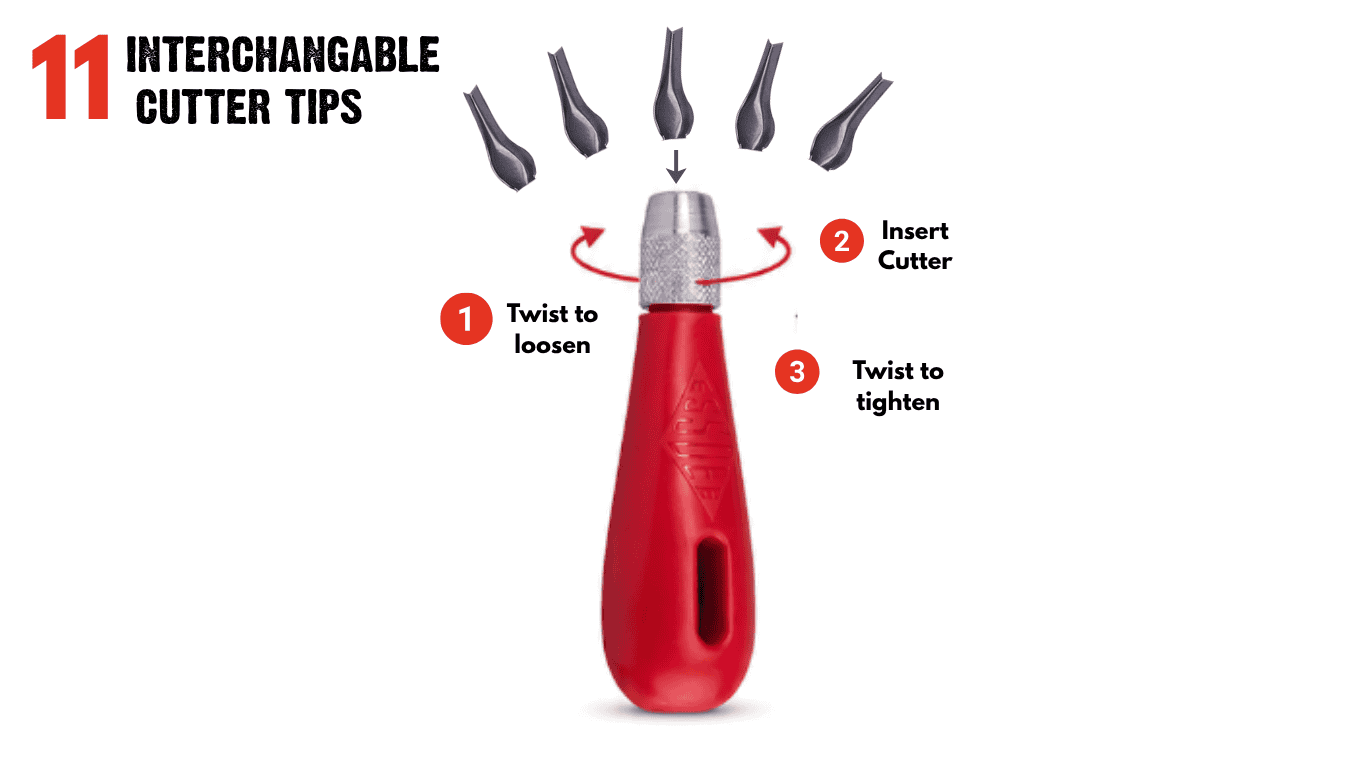
How do I change the cutters in my lino handle?
Do you have any tips for how I can store my lino cutters?
Our innovative Lino Cutter and Baren set includes the usual lino cutters and handle, but it can also be converted into a baren. The baren base doubles up as a storage unit to keep your cutters safe after use.
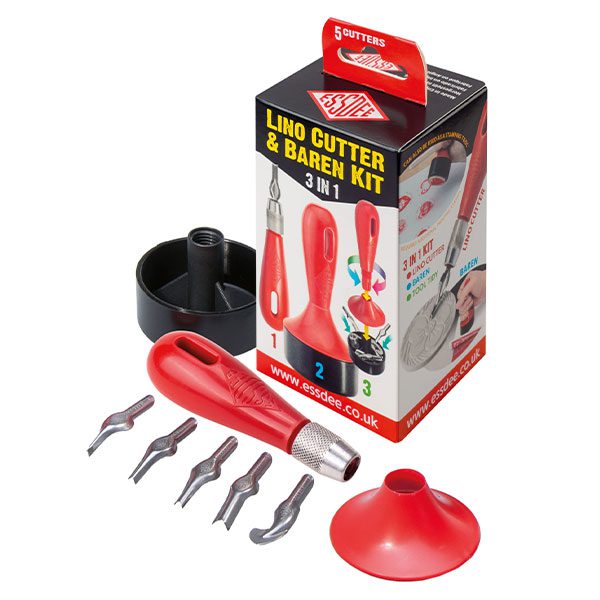
If you don’t have an Essdee baren, we would advise keeping your lino cutters in a container that will keep them dry and which is sturdy enough to keep the cutters safe. We find that a small plastic takeaway carton is ideal!
Have you got any tips on how to keep safe when carving my design?
Lino cutters are sharp, so you should always carve away from your hand/fingers. You can move the block around using your non-carving hand rather than constantly turning the cutter.
You should use a shallow angle between the cutter and the block, don’t dig too deep. You should also not use too much force when carving. Carving in this way will help to minimise the changes of slippage and the cutter making contact with your hand/fingers.
You could also use a Safety Hand Guard to protect your hand. The guard is held at the corner or top of the carving material, close to the area being cut. Any slippage is caught in the walls of the guard, protecting your hands for harm.
You may also want to consider using a bench hook. These keep your work steady. Simply place the bench hook on the edge of your desk or work surface for tidy, safe working.
PRINTMAKING PRODUCTS
Essdee products are used by illustrators and professional artists around the world. Click below to browse supplies for your next printing project.

Softcut

INKS
Lino Cutting Tools

Accessories
MEET THE Printmaker
We have spoken to Lino artists around the world to find out how they started using Lino, what inspires them, and their top tips. Read on to find out more.

Michał Klimczyk
Printmaker and papermaker Michał Klimczyk discusses handmade recycled paper, linocut printing, storytelling, sustainability and the inspirations behind his creative practice

Lynne Timmington
Discover Lynne Timmington’s scraperboard artwork, capturing nature and wildlife with remarkable realism. In this interview, she shares her inspirations, and passion for scraperboard.
Jack Ambro
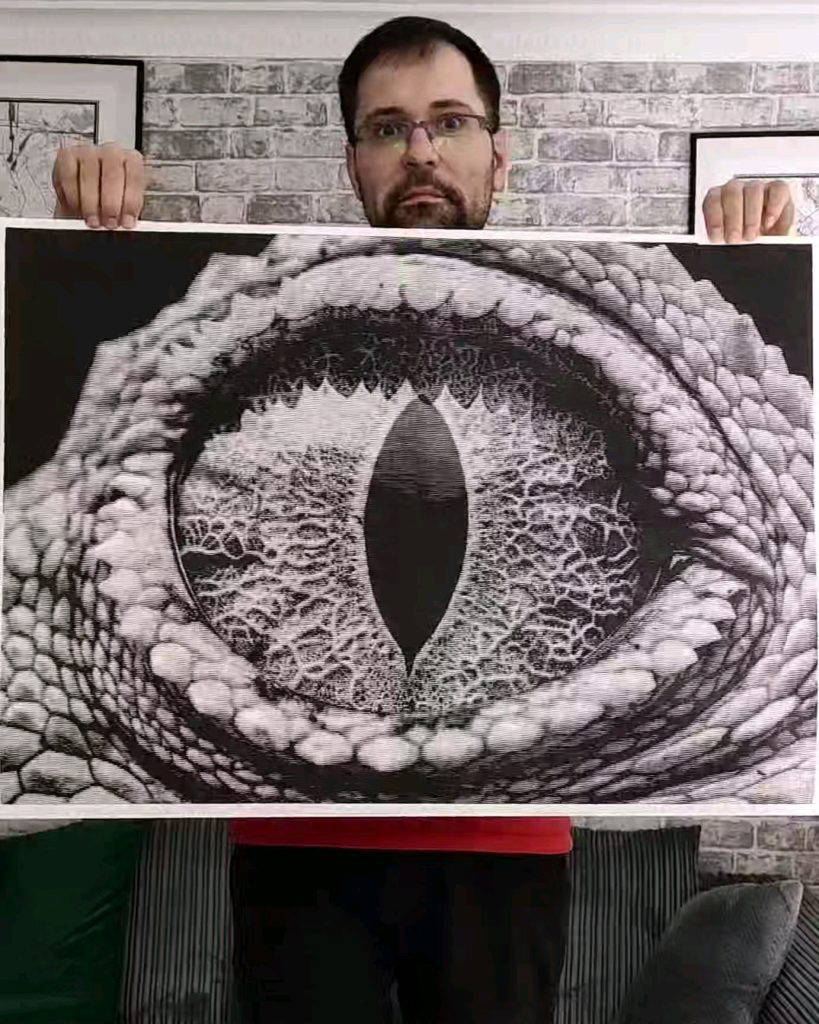
Jack Ambro Jacek Ambroszczyk, who works under the name Jack Ambro, is a Scotland-based linocut printmaker known for his large-scale, photorealistic prints. In this interview, he discusses his approach to halftone linocut, the surreal influences behind his imagery,...
HELPFUL ARTICLES & HOW TO’S
In this section, Lino artists provide a more in-depth insight into working with Lino. Read on to find out more.

Learn How to Lino Print onto Fabric
Learn how to lino to print onto fabric. Jodie gives us a step by step guide to lino printing onto fabric, using the example of creating a geometric print on a tote bag. Her blog is full of tips and advice to achieve the perfect fabric lino print.

How to Make a Monstera Leaf Lino Stamp
Hey there! This is Hayley from Buff and Blue.
I’ve been asked by the folks over at Essdee to do a little beginners tutorial to help you get started with the first steps into printing.
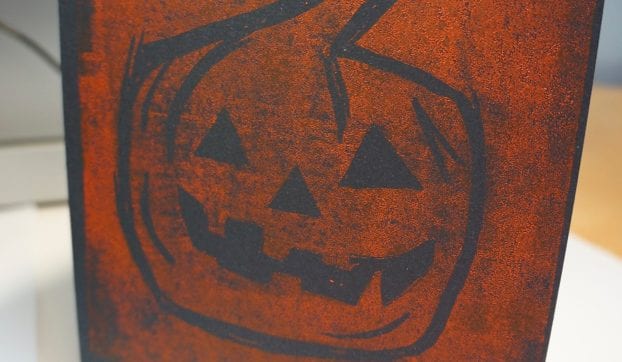
Make a Pumpkin Lino Print – A step by step guide
Learn how to make your own pumpkin lino print with our step by step guide. Our blog is full of tips to make the perfect halloween lino print.
- « Previous
- 1
- 2
- 3
Where to Buy our Products
Have you seen a product that you would like to buy? Find out where you can purchase it here.
DOWNLOAD OUR CATALOGUE
Send us a message
Contact Details
info@essdee.co.uk
(+44) 01562 60787
Essdee – Educational Art and Craft Supplies Ltd
Frederick Road, Hoo Farm Industrial Estate
Kidderminster, DY11 7RA

global.monkey.brave
Copyright Educational Art and Craft Supplies Ltd 2023 | Website Design by Nettl of Kidderminster